
Entrance Doors That Suit Your Home and Budget
- 17 September 2026|
- News
A new front door is one of the few home improvements you use every day, yet its impact reaches far beyond the hallway. The right entrance doors set the tone for your property, help retain warmth, resist unwanted entry and make arriving home feel better. The wrong choice can look out of place, underperform in poor weather or become a maintenance task you did not expect.
For homeowners across Hertfordshire and North London, the best solution is rarely simply the most expensive door or the one that looks best in a brochure. It is the door that suits the character of the house, the exposure of the entrance, the level of security required and the way you want to live.
What Should Entrance Doors Deliver?
A quality entrance door should balance four things: appearance, security, thermal performance and long-term reliability. These are closely connected, but one should not be chosen at the expense of another.
A bold contemporary door may suit a newly renovated home in Radlett or Harpenden, while a more traditional design may be a better fit for a period property in St Albans, Barnet or Harrow. Colour, glazing panels, hardware and proportions all matter. A door can be technically excellent, but if it overwhelms the brickwork, clashes with the windows or feels too modern for the property, it will not add the kerb appeal you hoped for.
Security deserves equal attention. Look beyond a reassuringly solid feel and ask how the whole entrance has been designed. A secure door relies on its frame, hinges, cylinder or locking mechanism, glazing specification and installation as much as the door leaf itself. Products tested to recognised standards, such as PAS 24 or relevant RC ratings, provide useful reassurance, particularly for exposed properties or homes that may be vacant during the day.
Thermal performance is also worth considering carefully. A poorly insulated entrance can create a noticeable cold spot in the hall, while draughts around the frame can undermine an otherwise efficient home. The best result comes from a well-made door, suitable insulated glazing where included, a correctly specified threshold and precise fitting.
Choosing the Right Material for Your Front Door
There is no single best material for every property. Each has practical strengths, and the right choice depends on your design priorities, budget and maintenance expectations.
Composite doors for everyday performance
Premium composite doors remain a popular choice for replacement projects because they offer a convincing traditional appearance alongside good insulation, strength and low maintenance. They are available in a broad range of styles, colours and decorative glass options, making them suitable for anything from a Victorian terrace to a detached family home.
The quality difference between composite doors can be significant. Construction, locking systems, weather seals, hinges and hardware all vary, so it is sensible to compare the complete specification rather than choosing on colour alone. A well-specified premium composite door can offer excellent value over many years.
Aluminium doors for contemporary homes
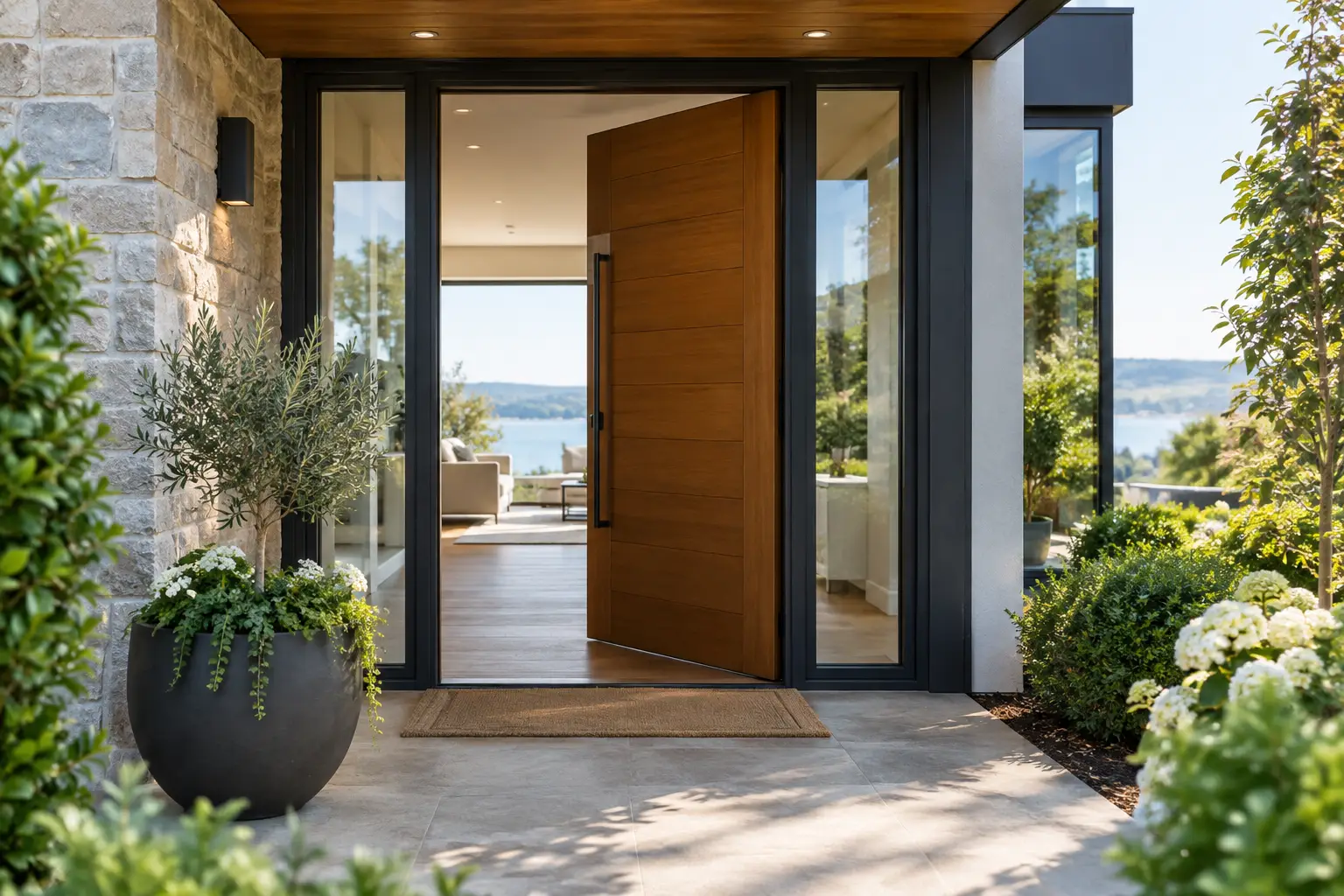
Aluminium entrance doors suit modern extensions, new-builds and homes with slimline aluminium windows, bifolds or sliding doors. Their strength allows for clean lines, larger panels and crisp detailing, while powder-coated finishes provide durable colour choices.
They can cost more than some conventional alternatives, especially where bespoke sizes, side panels or detailed glazing are involved. However, for a contemporary property, the visual consistency with other aluminium glazing can make the investment worthwhile.
Steel entrance doors for higher security and statement design
Steel entrance doors are increasingly chosen for luxury renovations and architect-designed properties. They provide exceptional strength, a distinctive architectural appearance and scope for advanced security features, including motorised locking, smart access, fingerprint recognition and facial recognition.
For homeowners with specific security concerns, selected systems may also be available with higher resistance ratings or ballistic-resistant certification. That level of specification is not necessary for every home, but it demonstrates how far entrance-door technology can go when security is central to the brief.
Timber doors for authentic character
Timber has a warmth and depth that is difficult to replicate, particularly on period homes and heritage-led projects. It can be shaped, painted or stained to complement original features, and it remains a strong choice where planning considerations or architectural character call for natural materials.
The trade-off is maintenance. A quality factory finish and careful installation will give timber a strong start, but exposed entrances may need periodic attention to protect the surface and preserve its appearance. This is not a reason to avoid timber. It is simply a decision to make with realistic expectations.
Design Details That Change the Whole Entrance
The door itself is only part of the picture. Side panels, fanlights, glazed sections, handles, letterplates and house numbers can transform both the look and practicality of an entrance.
Glazing brings useful daylight into a dark hallway, especially where the front elevation is shaded. Obscure, textured or decorative glass can preserve privacy while allowing light through. For a busy road or overlooked entrance, it is worth thinking about sightlines from the pavement as well as from inside the house.
A side panel can make a narrow hallway brighter and create a more generous entrance, but it needs to be specified with security and insulation in mind. Large areas of glass are not automatically a weakness when the correct toughened or laminated safety glazing and secure framing are used.
Hardware should suit the style of the property and be comfortable to use. A long pull handle can look right on a contemporary aluminium door, whereas a traditional knocker and lever handle may be more appropriate for a classic composite or timber design. Finishes matter too. Choose one that works with nearby exterior details such as lighting, railings and door furniture, rather than treating it as an afterthought.
Security Is About More Than the Lock
Homeowners often begin by asking which lock is best. It is a sensible question, but a secure entrance is a complete system. The door must sit correctly in a strong frame, lock cleanly, close tightly and resist attack at likely weak points.
Ask your installer to explain the locking arrangement in plain language. You should understand how the multi-point locking works, what type of cylinder is fitted where applicable, whether the hinges include security features and how any glazed areas are protected. Smart locking can add convenience, particularly for families, landlords or anyone managing regular access, but it should complement physical security rather than replace it.
Installation is critical. Even a high-performance door cannot perform as intended if the opening has not been surveyed accurately, the frame is not fixed properly or the seals are poorly adjusted. This is why an on-site survey should be treated as a key part of the project, not an administrative step after a sales conversation.
Avoiding Common Replacement Door Mistakes
The most common mistake is choosing from a photograph without considering the existing opening. Front doors are often bespoke because older properties may have uneven reveals, unusual brickwork, existing side screens or thresholds that require careful detailing.
Another is focusing only on the advertised door price. The quotation should make clear what is included: survey, removal of the existing door, disposal, frame, glazing, hardware, locks, trims, making good and installation. Transparent pricing helps you compare like with like and reduces the risk of unwelcome additions later.
It is also worth considering the entrance in all seasons. A sheltered porch creates very different conditions from a door facing driving rain and winter wind. Finish, drainage, threshold design and weather seals should reflect the location. Likewise, a south-facing entrance may place greater demands on darker colours and exposed finishes over time.
Finally, do not leave decisions about colour and glazing until the end. Samples viewed in natural light are far more useful than screen images, and a colour that looks striking on a small swatch may feel very different across a full-height door.
A Straightforward Route from Idea to Installation
A good door project should feel clear from the first discussion. Start by identifying what is not working with the existing entrance – perhaps it feels draughty, looks dated, lacks daylight or no longer gives you confidence in its security. Then consider the property style, the material options and the features that genuinely matter to your household.
At E&A Windows, the process is guided by practical advice rather than hard sales. A detailed survey confirms the dimensions and site requirements before manufacture, while experienced installation ensures the finished door looks right, operates smoothly and is properly weather-tight. Clean workmanship and clear communication are particularly valuable when a front entrance is temporarily out of use.
If you are renovating the wider property, consider the front door alongside replacement windows, porch glazing and exterior finishes. Matching sightlines, colours and hardware can give the home a more considered appearance than changing each element separately.
The best time to choose an entrance door is before you feel forced into a quick replacement. Give yourself space to compare materials, handle samples and think through the practical details. A carefully chosen door should welcome you home with confidence for many years, whatever the weather brings.